

You’re giving your pup their evening scratch-down when your fingers land on something that wasn’t there yesterday, a lump on your dog’s leg. Your stomach drops. Your mind races. Before you spiral into worst-case scenarios, take a breath. A lump on a dog’s leg is one of the most common reasons pet owners visit the vet, and the majority of cases turn out to be far less alarming than that first moment of discovery.
Although “don’t panic” doesn’t mean “don’t do anything”, the difference between recognizing a harmless lump of fat versus a harmful lump that requires urgent care can literally mean life or death; therefore, this guide will provide all necessary information including33Common causes of tumors associated with canine limb lacerations, symptoms that differentiate benign from malignant;92Signs that warrant calling your veterinarian immediately.
What a Lump on Your Dog’s Leg Actually Means
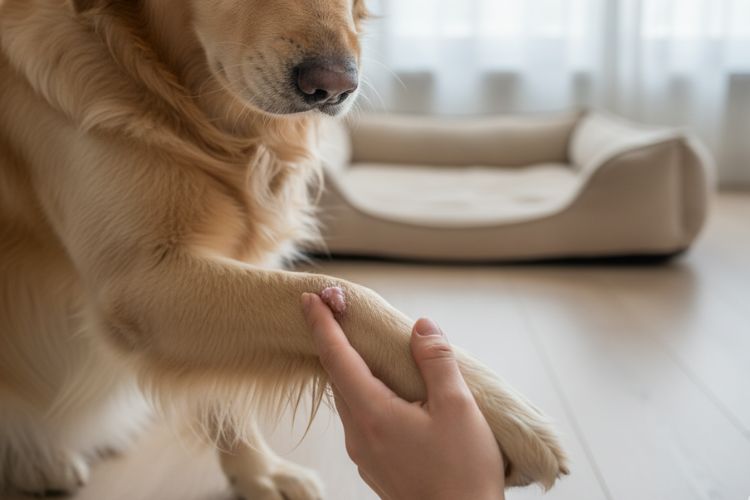
There are a lot more skin growths on dogs than many people realize; dogs have skin that’s affected by hormonal changes, environmental irritants, and age, as well as complete immune response characteristics, so it is easy for a dog to develop a bump, swelling, or mass within a 24-hour period. A lump on your dog’s leg could be found on the surface of the skin, slightly below the surface, or quite deep within the muscle tissue. Each type of location tells a different story, so when you discover any type of lump on your dog’s leg, you should have it evaluated by your veterinarian.
The causes of lumps on the leg can vary significantly from benign to malignant, depending entirely on the size of the lump and other physical characteristics such as the texture of the lump, the growth rate of the lump, the location of the lump, whether or not the lump is painful, and how your dog is doing overall health-wise. These are all data points that your veterinarian will need to make an accurate diagnosis. A dog with a small, hard mass is generally going to have much more clinical significance than a dog that has a very large, soft mass.
Quick Tip: The moment you find a lump, measure it and note the date. Photographing it weekly against a ruler gives your vet an objective record of any changes. Steady size over weeks is generally reassuring; rapid growth over days warrants an urgent call.
Common Causes of Lumps on a Dog’s Leg
There is no single explanation for why a lump appears on a dog’s leg. The causes of lumps on a dog’s leg are varied, and understanding them helps you have a more informed conversation with your veterinarian rather than arriving in a fog of anxiety.
Lipomas (Fatty Tumors)
Lipomas are one of the most common causes of lumps on a dog’s leg, especially in older dogs. These fatty growths feel soft, smooth, and movable under the skin. You may notice a soft lump on the dog’s leg around the thigh or upper leg area. Most lipomas are harmless, but it’s still important to have them checked by a vet to rule out more serious growths.
Sebaceous Cysts
Sebaceous cysts form when an oil gland becomes blocked, creating a small, raised bump filled with thick material. They can appear on the legs, lumps on a dog’s neck, or even near the dog’s lump under the armpit area. These cysts are usually harmless and may burst on their own. Avoid squeezing them, as that can lead to infection or irritation.
Abscesses
An abscess is a pocket of pus that forms when bacteria breach the skin, typically through a bite wound, thorn puncture, or scratch your dog sustained during outdoor adventures. On the leg, abscesses can swell surprisingly quickly and become warm, tender, and visibly discolored. Unlike lipomas or cysts, abscesses are uncomfortable and always require veterinary treatment; they need to be properly drained and treated with antibiotics to prevent the infection from spreading.
Histiocytomas
Histiocytomas are bright red, button-like growths mostly seen in dogs under three years old. They can appear suddenly and often worry pet owners, but they’re usually harmless and disappear on their own within a few months. If the lump becomes irritated or your dog keeps scratching it, a vet should examine it to rule out other symptoms of a lump on a dog.
Mast Cell Tumors
Mast cell tumors are the most common form of skin cancer in dogs and are known among veterinarians as “the great imitators, they can look like almost anything. A mast cell tumor on the leg might resemble a soft fatty lump one week and appear firm and irregular the next, since these tumors can actually change in size due to histamine release. This unpredictability is precisely why any lump on a dog’s leg that changes quickly or feels inconsistent to the touch should be evaluated without delay. Early detection and surgical removal significantly improve outcomes.
Enlarged Lymph Nodes
Swollen lymph nodes can develop due to infection, inflammation, or more serious conditions like cancer. Common areas include lumps on a dog’s neck, the lump under the armpit area, and behind the knee near the hind leg. Since enlarged lymph nodes can signal an underlying health issue, it’s important to have them checked by a vet promptly.
Symptoms of a Lump on a Dog You Shouldn’t Ignore

Not every lump announces itself loudly. Many dogs will carry a growth for weeks without showing obvious distress, which is why regular hands-on checks during grooming or play are genuinely valuable. The symptoms of a lump on a dog vary depending on its nature, but there are specific warning signs that should accelerate your timeline for veterinary contact.
- Rapid growth over days rather than weeks or months
- A hard, fixed lump that doesn’t move when pressed
- Irregular, poorly defined edges that seem to blend into surrounding tissue
- Open sores, crusting, or bleeding on or around the lump
- Redness, heat, or swelling that spreads beyond the lump itself
- Visible pain; your dog flinches, whimpers, or guards the area when touched
- Limping or changes in gait, especially if the lump is near a joint
- Loss of appetite, weight loss, or lethargy alongside the lump
It’s also worth paying attention to less obvious companion signs. A dog with an irritating or painful growth will often engage in repetitive dog itching, licking, or chewing at the site, behaviors that can cause secondary skin infections if left unchecked. If you notice your dog fixating on one spot on their leg, investigate closely, even if you can’t immediately see or feel anything obvious.
When to Call the Vet Immediately: If a lump on your dog’s leg appears alongside difficulty breathing, sudden collapse, dramatic swelling of the face or limbs, or any bleeding that doesn’t stop within a few minutes, treat this as an emergency. Allan Veterinary Clinic does not handle trauma or critical emergencies; the nearest 24/7 facility is Westbridge Veterinary Referral Hospital in West Bridgewater, MA: (508) 584-1600.
Location Matters: What Different Spots Are Telling You
Where a lump sits on or near the leg can offer important context before your vet even runs a test. A soft lump on a dog’s leg along the inner thigh is more likely to be a lipoma than a tumor. A firm, fast-growing nodule on the lower leg near a scratch is more consistent with an abscess. Lumps on a dog’s neck, a dog lump under the armpit, or behind the knee are more likely to involve lymph nodes and merit a faster response, given that lymph node swelling can indicate systemic disease.
Lumps that appear directly in or around a joint, particularly the knee or elbow, sometimes point to bone-related conditions, including osteosarcoma in larger breeds. These lumps are often accompanied by progressive lameness that doesn’t improve with rest. If your large-breed dog is limping and you’ve found a growth near a joint, don’t wait to see if it gets better on its own.
The causes of lumps on a dog’s leg that are associated with the paw and lower leg often include warts (papillomas), corns, or interdigital cysts, growths between the toes that can be especially painful and may cause your dog to favor that foot dramatically. While these are typically benign, they can become infected and may require veterinary treatment to resolve fully.
What Happens at the Vet: Diagnosis and Treatment Options
Your vet will usually start with a fine needle aspiration (FNA), a quick test that uses a small needle to collect cells from the lump. The sample is checked under a microscope to see if the lump is harmless or something more serious.
If the results are unclear, a biopsy may be needed. This involves taking a small tissue sample or testing any fluid inside the lump for a more detailed analysis.
Treatment depends on the diagnosis. Some harmless lumps are simply monitored over time, while infections or cysts may be treated with medication. If the lump is cancerous, growing quickly, or affecting movement, surgery may be recommended. At Allan Veterinary Clinic, lung removal surgery for dogs can be done with local anesthesia for suitable cases.
Good News for Most Dog Owners: The majority of lumps discovered during routine vet checks turn out to be benign. The earlier a lump is evaluated, the more straightforward the path to reassurance or treatment, if needed.
Frequently Asked Questions
Can a lump on a dog’s leg go away on its own without treatment?
Some can, histiocytomas and minor cysts often resolve on their own. But don’t guess. Abscesses and mast cell tumors won’t disappear without treatment, so always get a new lump checked before taking a “wait and see” approach.
How can I tell if a soft lump on a dog’s leg is dangerous at home?
You can’t, not reliably. A freely moving, stable lump is usually reassuring, but feeling alone can’t rule out cancer. Only a fine needle aspiration or biopsy from your vet gives you a definitive answer.
My dog has lumps on the neck and near the armpit. Should I be worried?
Lumps on a dog’s neck and a lump under the armpit often signal swollen lymph nodes. This can be as minor as a passing infection or as serious as early lymphoma; either way, book a vet visit promptly rather than monitoring alone.
Is lump removal surgery for dogs a major procedure?
Not always. Small, surface-level lumps can be removed under local anesthesia with a short recovery, exactly what Allan Veterinary Clinic offers. Deeper or larger growths may need general anesthesia. Your vet will recommend the right approach for your dog’s specific case.
Noticed a Lump on Your Dog’s Leg?
Don’t leave it to guesswork. Our compassionate team at Allan Veterinary Clinic, is here to give you real answers; quickly, honestly, and affordably. We’re accepting new patients, and walk-ins are welcome.
Call us: 508-638-9030 | 627 Pleasant St, Brockton, MA | allanveterinaryclinic.com
This article is for informational purposes only and does not constitute veterinary medical advice. Always consult a licensed veterinarian for diagnosis and treatment of your pet.